Starting a VA business? Three illustrated guides for running a virtual assistant business: your rate, packages, retainers and the agreement; finding and keeping clients; and the work itself, shown as one-page SOPs. One idea a page, each one drawn.
Real pages from all three guides. One idea a page, drawn, with the money worked out.
Start Your VA Business, Finding and Keeping Clients, and The Work, Shown. 116 pages, one idea each.
The idea, the picture, the steps to do it yourself and the costly mistake. Read it between client tasks.
Phone-sized PDFs to check before a discovery call or a quote, yours to keep. Nothing to cancel.
You know how to run an inbox. Nobody taught you the business.
Most of the money a new VA loses goes quietly: a rate copied from a forum, hours you can't bill left out of it, a package with no cap, extra hours worked before anyone agreed to pay, a discount to win the first client. Every one of them has a page, and every page names the mistake.
The money pages: where VAs lose money

A drawing is easier to take in between client tasks than a paragraph. That's why every page in the kit has one, and one mistake to skip.
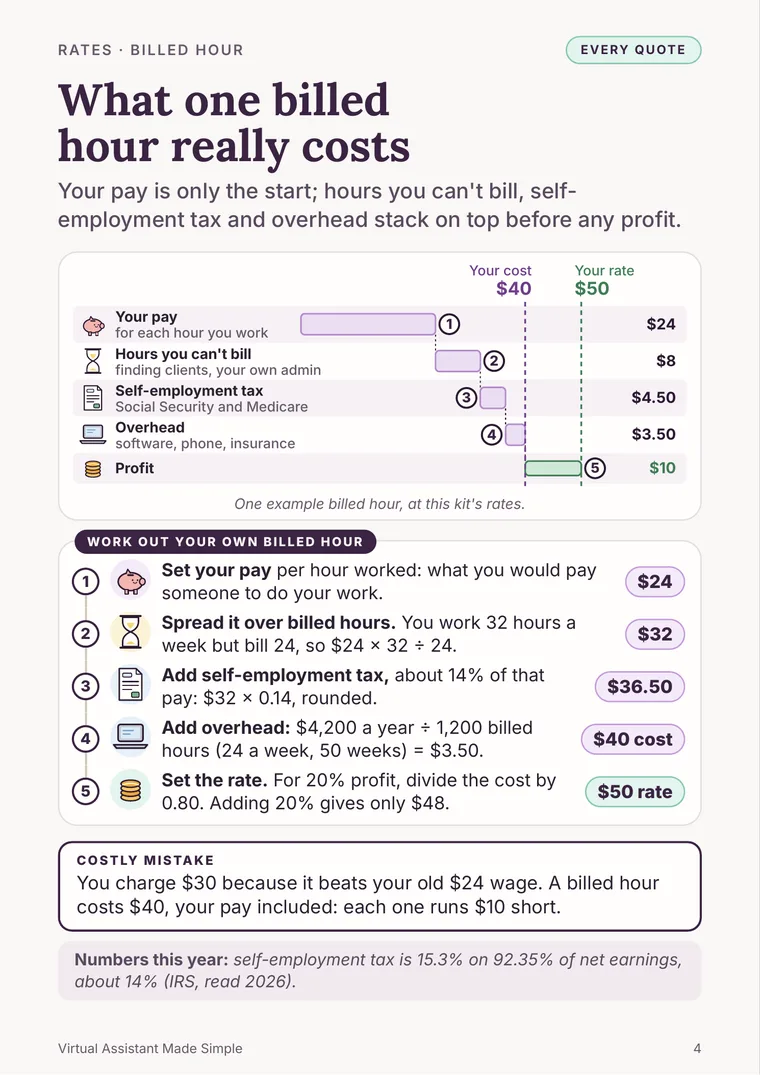
Every page has the same parts, so you always know where to look. Here is Book 1, page 4, What one billed hour really costs, with its lines quoted from the guide.

Your pay is only the start; hours you can't bill, self-employment tax and overhead stack on top before any profit.
Set the rate. For 20% profit, divide the cost by 0.80. Adding 20% gives only $48.
You charge $30 because it beats your old $24 wage. A billed hour costs $40, your pay included: each one runs $10 short.
Self-employment tax is 15.3% on 92.35% of net earnings, about 14% (IRS, read 2026).
Quoted word for word from Book 1, page 4. The $24 pay, the $40 cost per billed hour and the $50 rate on the page are the kit's example figures, labelled as examples. Every page carries these parts plus the drawing, and where a rule changes from state to state, a note that says so.
Money first: the services, your rate, packages, retainers and the agreement, then getting paid, setting up, profit and taxes, one idea a page. Six parts: The business, Rates and pricing, The agreement and getting paid, Setting up, Profit and cash, and Taxes as a freelancer. Start with what one billed hour really costs.
Who hires a VA, getting found, outreach, the discovery call and proposal, onboarding, keeping clients and growing, in the same layout.
The work itself, one SOP to a page and each drawn as a flow, so every task you sell runs the same way every time and you can time it before you price it.
Total value: $95
One-time payment. No subscription. Keep the files forever.
Digital guides (PDF), in English. We email your library link right after purchase, and you can download the files again anytime. Plus sales tax where applicable.
Virtual Assistant Made Simple is an independent guide for people running a virtual assistant business. It explains rules and practice in plain words, is not legal, tax or accounting advice, and does not promise any income or business result. It is not affiliated with any government agency, platform or association.
You can run an inbox and a calendar; the business side is new. Book 1 sets your services, the work to turn down, registering, your rate and your client agreement before the first client asks what you charge.
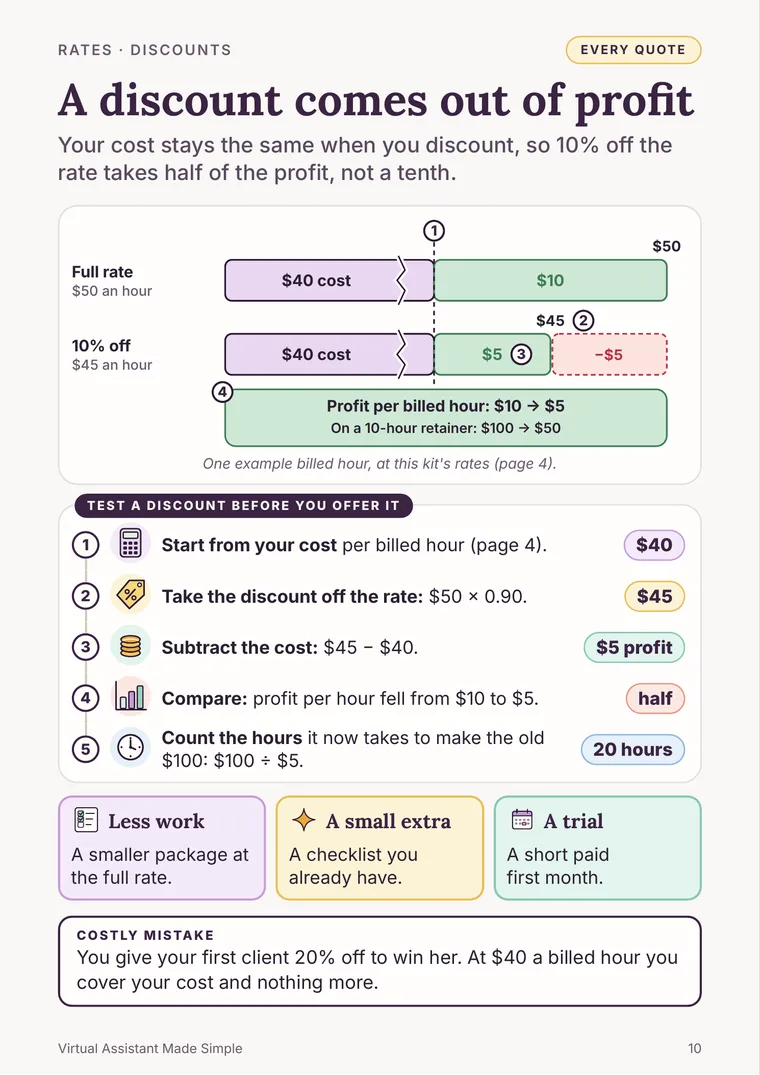
The hours are full and the account isn't. Your cost per billed hour, packages with a cap, retainers paid before the month, overage, discounts and what each client really pays per hour each get a page, worked with example numbers you swap your own into.
Book 2 covers your niche and offer, getting found, a warm message and a short cold email, the discovery call, a proposal with three options and the first 30 days, then keeping clients and raising your rate.
No gimmicks and no income promises. Built on federal rules, state and city pages as labelled examples, and standard freelance practice, drawn clearly, with the source named on the page where it matters.
The tax pages follow IRS topics and publications for the year; the contractor page follows the IRS's worker-status guidance; the limits pages name the rules for tax returns, legal papers, real-estate work and patient data; the outreach and review pages follow the FTC's email and review rules. Every page was checked against its named sources before release.
Business names, city licenses, LLC filings, late fees and sales tax on services change from state to state and city to city. Those pages teach the shared pattern, label any one rule as an example, and point you to where yours lives.
The money pages work the same example numbers all the way through: $24 of pay per hour worked, $40 of cost per billed hour, a $50 rate, a 10-hour retainer at $500 and an invoicing package at $250. You can see where each number comes from and swap in your own. The examples are examples, not rates for your market and not what you will earn.
Not affiliated with or endorsed by Google, Microsoft, Canva, Upwork, Fiverr, Intuit, any virtual assistant association or certification body, the IRS, HHS, the FTC, any state bar, real estate commission or licensing board, or any government agency. We answer to the VA.
Use the kit for 7 days. If it isn't for you, email us and you get 100% of your money back. No fine print, no hassle.
Right after purchase we email you a link to your library, where you download all three guides as PDFs. You can come back and download them again anytime.
One-time payment of $27. No subscription, no recurring charges, and nothing to cancel. All three guides are yours to keep.
People starting a solo virtual assistant business from home, before or just after the first client, and VAs in their first year who want their rates, retainers and agreement set up properly. It is a guide to running the business, not a job board or a certification.
No, it's the best time. Book 1 sets your services, your rate and your agreement before the first client asks, and Book 2 shows how to find and keep clients. Every number is a labelled example you swap for your own.
No, and we'd be wary of anyone who does. Income depends on your clients, your hours and you. The guides show you how to price your time so each billed hour covers its cost, and the mistake that costs money, with the numbers worked on the kit's example figures. They don't promise any income or clients.
Every state. The books teach what works the same way everywhere: rates, packages, retainers, agreements, clients and the work itself. Where a rule changes by state or city, like a business name filing, a city license or sales tax on services, the page says so and shows you where to look up yours.
No. Virtual Assistant Made Simple is an independent guide for people running a virtual assistant business. It explains rules and practice in plain words, is not legal, tax or accounting advice, and does not promise any income or business result. It is not affiliated with any government agency, platform or association. Your lawyer, your accountant (CPA) and your city or state office apply the rules to your business.
No. The kit is complete on its own.

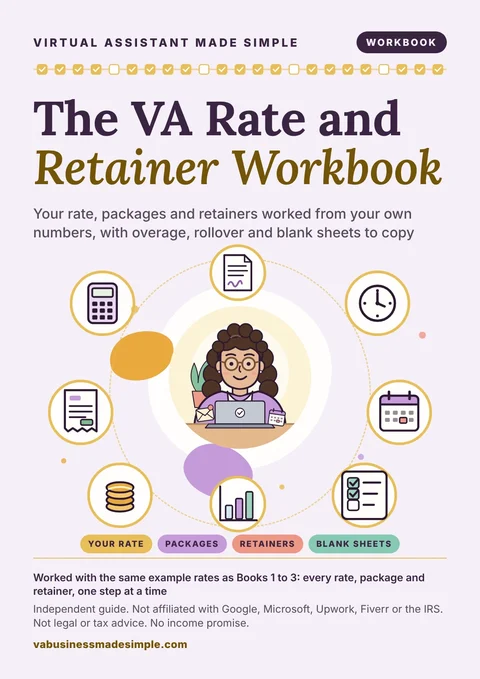
At checkout there is one optional add-on, The VA Rate and Retainer Workbook: your pay, hours, overhead and cost per billed hour, your rate, task timing, an inbox and an invoicing package priced, a retainer in three sizes, overage and rollover, a proposal priced three ways, and blank sheets for your own. It's $9, unticked, and you can skip it.
Both. The pages are portrait and phone-sized, so you can check one before a discovery call, and the PDFs print if you want an SOP beside your desk.
Email us within 7 days of purchase and we'll refund 100% of your money. Details on the refund policy page.
Spotted an error, or a rule that works differently in your state? Email [email protected]. A real person reads every message, and fixes go into the next version.
Every month on your own teaches you something about the business side, and the expensive lessons come with a bill. You don't need another midnight group thread or a rate someone swears by. You need the page for this decision, with the money worked out and the mistake named. Built for VAs who want every billed hour to cover what it really costs.